 Jitterbit iPaaS
 Jitterbit EDI
 Jitterbit API Manager
 Jitterbit MCP
 Jitterbit App Builder
 Marketplace
 Management Console
 Cloud Datastore
 Message Queue
 Jitterbit AI
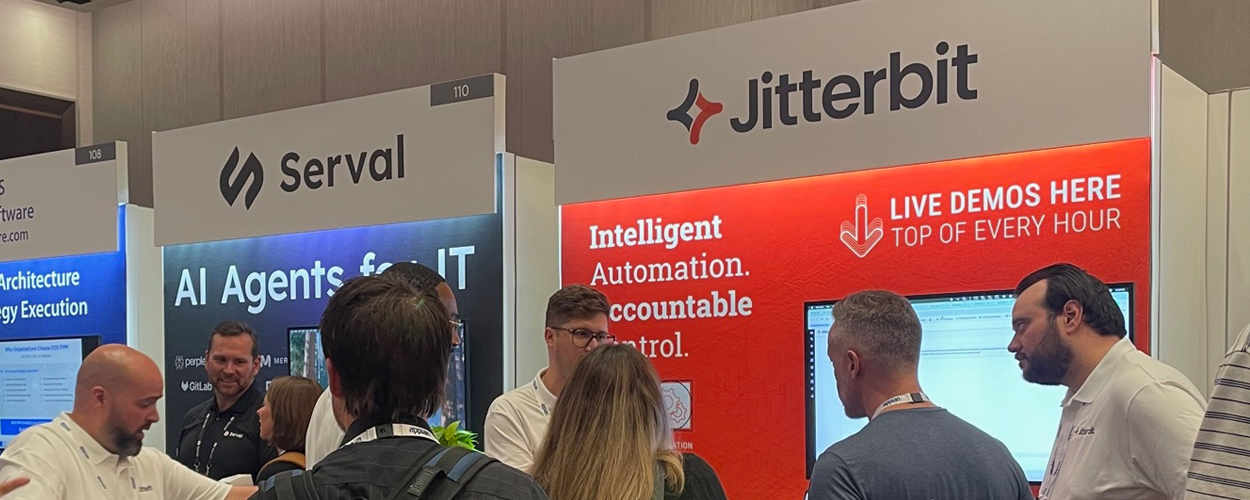
By Maneeza Malik, Product Marketing Director
At this year’s Gartner Application Innovation & Business Solutions Summit in Las Vegas, agentic AI dominated the conversation. Integration emerged as the critical “last mile.”
Across keynotes, analyst sessions, vendor roundtables and customer discussions, one message consistently stood out: AI agents create true value when they are accountable and connect seamlessly to enterprise applications, data, workflows and systems.
Comprehensive integration, combined with robust agent-to-system and agent-to-agent orchestration, allows organizations to scale adoption and deliver tangible business outcomes.
Jitterbit engaged directly with attendees at our booth and hosted an exclusive roundtable with representatives from Fortune 1000 organizations. What we heard consistently reinforced the same point: AI agents are only as effective as the systems and data they can securely access.
This reality drives growing interest in unified platforms like Jitterbit Harmony. Harmony brings together iPaaS, app development, APIs, EDI, and emerging agent infrastructure such as MCP servers. It gives users the ability to build, deploy, manage and govern AI agents securely within a single environment, with comprehensive AI governance built in at every stage.
Over the three-day event, five distinct insights redefined our view of the enterprise landscape:
1. Agentic AI is moving from pilots to production
The biggest shift was Gartner’s emphasis on outcomes over hype. The conversation has moved beyond whether AI agents can generate content or answer questions. Today, it’s all about whether they can execute tasks, make recommendations and take autonomous action that delivers measurable business value.
As agents move into production, organizations are beginning to focus on performance measurement. For instance, key metrics include accuracy, task success rates and business impact. Human-in-the-loop workflows are also becoming important for oversight and exception handling.
Successful organizations will be those that operationalize agents across well-scoped, high-impact business workflows and use cases.
2. Integration establishes the foundation for execution
AI value is directly tied to its connectivity with enterprise systems. Agents only deliver meaningful outcomes when they can access trusted data, invoke APIs, trigger workflows and interact with systems of record.
Multi-agent environments heighten this requirement. In these landscapes, agents must interoperate and discover each other based on specific capabilities. As a result, integration forms the core foundation of agentic AI execution, linking intelligence to enterprise systems through APIs, workflows, and low-code application and integration platforms.
3. Application modernization is becoming AI-driven
Organizations are increasingly evaluating application portfolios through an AI lens. Successful architectures feature specific characteristics:
- Can systems expose APIs and business services?
- Can agents securely access data and workflows?
- Are architectures flexible enough to support future AI capabilities?
- Are AI assistants available to support application and integration development?
- Do systems provide the layered security, rigid governance and absolute accountability required to manage autonomous actions?
4.MCP is moving into the enterprise stack
Some of the most interesting sessions at the Gartner Summit were focused on MCP. What began as a way to connect models to tools and data sources is quickly becoming a foundational layer for agent architectures.
Adoption is accelerating across the ecosystem, with major providers including AWS, Microsoft, Salesforce, Oracle, OpenAI, Anthropic and Google — along with iPaaS vendors like Jitterbit — building MCP capabilities into their platforms. Gartner highlighted this expanding industry adoption.
The discussion has now shifted from whether MCP will gain traction to how organizations can operationalize it securely, govern it effectively, and use it to connect agents with enterprise systems at scale.
5. AI accountability becomes a foundational pillar for enterprise AI
As AI agents become embedded in business processes, the challenge shifts from building AI to governing it. Enterprises need robust accountability frameworks that define how AI systems are monitored, controlled, updated and ultimately retired. This includes maintaining transparency, preventing model and agent drift, enforcing security and compliance policies, and ensuring that autonomous actions remain aligned with business intent. Organizations that can combine AI innovation with strong accountability will be best positioned to scale AI safely, securely, and with confidence.
Final Thoughts
My biggest takeaway from the summit is that scaling agentic AI comes down to integration as the “last mile.” Long-term success will depend on connected applications, adaptable architectures, and strong integration foundations that turn intelligence into action across enterprise systems, data and workflows.
Gartner’s focus on modernization, architecture, governance and business process transformation underscored a fundamental truth that aligns perfectly with our core philosophy. True transformation requires both intelligent automation and accountable control. Bringing these forces together allows enterprises to secure their data environments, manage agent lifecycles and confidently unleash their full business potential.