
 Jitterbit iPaaS
 Jitterbit EDI
 Jitterbit API Manager
 Jitterbit MCP
 Jitterbit App Builder
 Marketplace
 Management Console
 Cloud Datastore
 Message Queue
 Jitterbit AI
Jitterbit MCP Activate your agentic enterprise with accountable AI.
The foundation for enterprise AI integration.
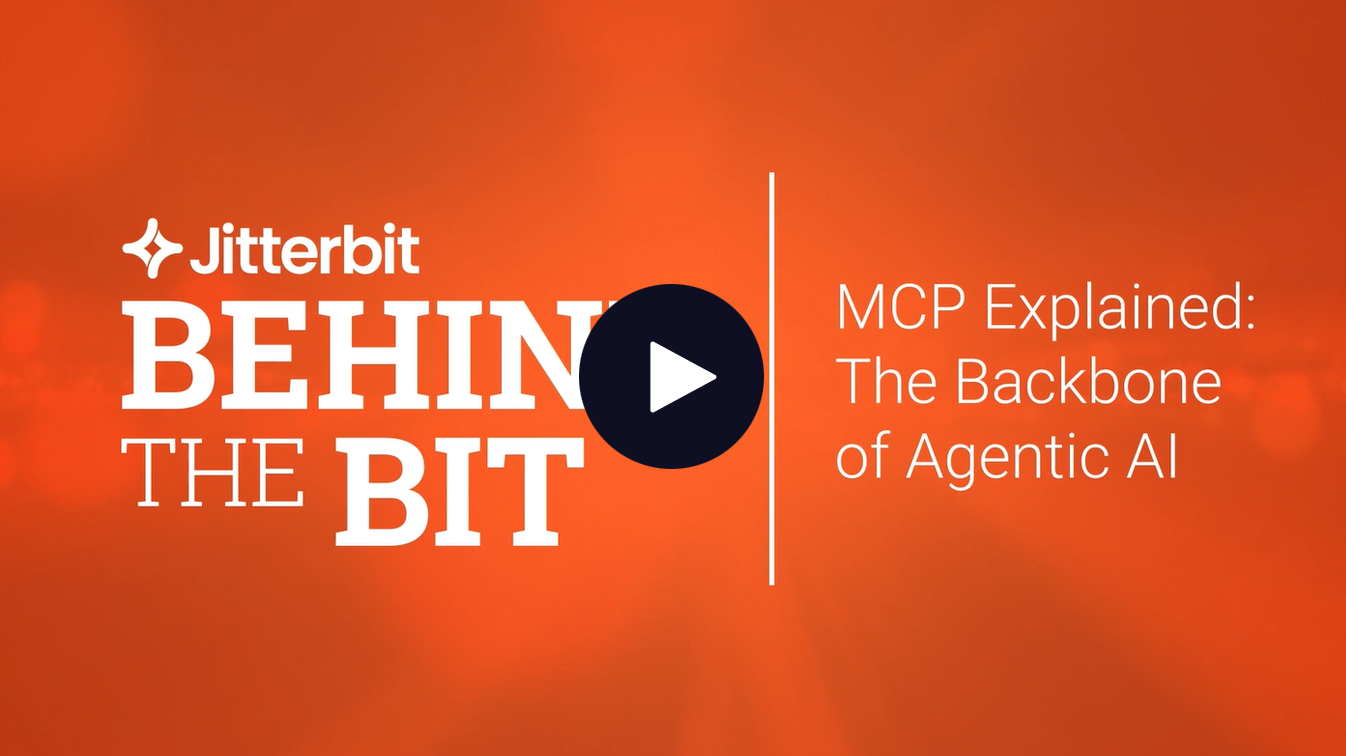
Secure, scalable AI across the enterprise.
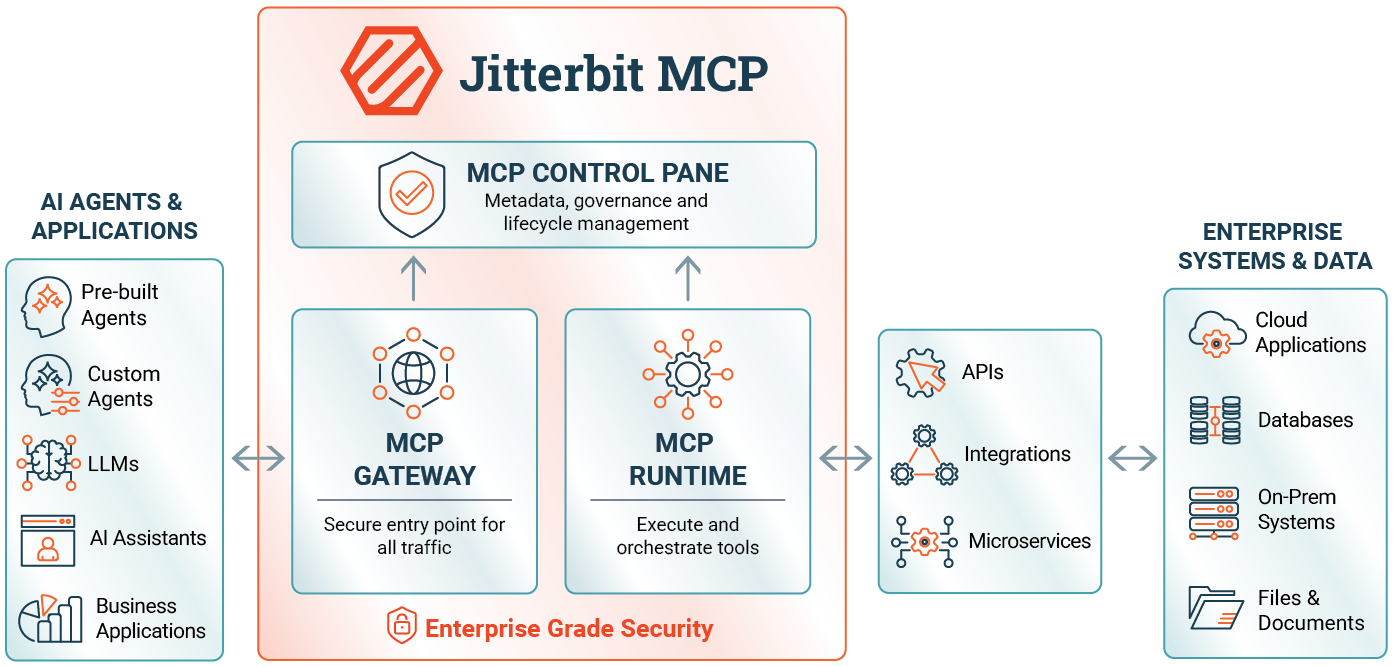
Jitterbit delivers enterprise-grade MCP, transforming existing APIs and integrations into reusable, agent-ready capabilities.

Simplify Setup
Securely enables creation, exposure and management of MCP servers without custom development.

Centralize Control
Provides governance, identity management and policy enforcement across all AI interactions.

Manage Traffic
Orchestrates data flow between AI agents and your systems, whether that’s in the cloud, on-premises or across hybrid environments.

Secure Sensitive Data
Identifies and secures sensitive data in real time as it moves across the platform with Deep Message Inspection (DMI).
The rise of shadow AI and agent sprawl has created a massive governance gap for the modern enterprise.We are building Jitterbit MCP to bring order to this chaos, providing a secure, centralized framework that standardizes how AI models and agents access enterprise data while ensuring every interaction follows the same strict security policies as human users.”

Manoj Chaudhary
CTO, Jitterbit
What Jitterbit MCP unlocks for enterprise AI.
Jitterbit MCP turns existing APIs and integrations into secure, agent-ready capabilities without rebuilding systems. It gives enterprises a governed, scalable foundation to deploy and manage AI-driven workflows, resulting in:
- Faster Time to Value: Reuse your existing APIs and integrations as agent-ready tools to accelerate AI deployment.
- Stronger Governance: Centralized policies ensure consistent security, compliance, and access control across all AI agents.
- Built-in Security & Compliance: Identity management, gateway protections, and Deep Message Inspection safeguard sensitive data and ensure auditability.
- Interoperability by Design: Standardized protocol support allows you to use different LLMs without breaking integrations.
- Reliable, Scalable Execution: Runtime controls and guardrails prevent failures and ensure consistent agent behavior at scale.
- Simplified Development: Developers reuse existing integrations as MCP tools and focus on business logic instead of connectors.
Ready to accelerate your business with AI?
Contact an AI Expert



Frequently Asked Questions
What is Model Context Protocol (MCP)?
Mixed Context Protocol (MCP) is an open standard framework for agentic AI that defines how intelligent agents share, interpret, and coordinate across multiple contexts (such as tools, data sources, and other agents) in a consistent, structured way. It enables interoperability and dynamic collaboration by standardizing how context is packaged, exchanged, and updated during complex, multi-step tasks and workflows.
Why is MCP important?
MCP is important because it provides a shared standard that lets agentic AI systems reliably exchange and interpret context, reducing fragmentation across tools, data sources, and agents. By enabling consistent coordination and interoperability, it makes complex, multi-step workflows more scalable, maintainable, and trustworthy.
What problems does MCP solve?
MCP solves enterprise challenges around fragmented systems and inconsistent data/context sharing by providing a standardized way for AI agents, tools, and services to communicate. It also reduces integration complexity and operational risk by enabling reliable coordination across workflows, improving scalability, governance, and auditability.
What are the key benefits of MCP?
The key benefits of MCP for enterprises include reduced integration complexity, by standardizing how systems and AI agents share context across tools and data sources. Improved scalability, by enabling coordinated, multi-agent workflows that can grow without brittle custom integrations. Lastly, stronger governance and reliability, through consistent context handling that supports auditing, control and more predictable outcomes.
What makes Jitterbit MCP "enterprise-ready"?
Jitterbit’s enterprise MCP is built on the existing Jitterbit Harmony platform. That means that, unlike standalone MCP servers, Jitterbit combines MCP with iPaaS, EDI and API management. This allows AI agents to execute tasks across the entire enterprise. It also means that enterprise-grade security, governance and auditability are built in from the start, allowing businesses to operationalize AI with confidence.