 Jitterbit iPaaS
 Jitterbit EDI
 Jitterbit API Manager
 Jitterbit MCP
 Jitterbit App Builder
 Marketplace
 Management Console
 Cloud Datastore
 Message Queue
 Jitterbit AI

By Tomydas Pall, Group Product Manager
AI assistants and copilots have already helped users generate content, retrieve information and work more efficiently. The next phase is AI agents: intelligent systems that can pursue goals, make decisions and execute tasks across enterprise systems.
Industry analysts expect rapid growth in this area. Gartner predicts that by 2028, 70% of organizations building multi-LLM applications and AI agents will rely on integration platform capabilities to orchestrate access to tools and data, up from less than 5% in 2024.1
That is the challenge Jitterbit MCP was built to solve.
How do you allow AI agents to securely access systems, use the right tools and take action across the enterprise, without creating fragmented integrations, security gaps or governance risk?
The answer is Jitterbit MCP.
What Is Jitterbit MCP?
Jitterbit MCP is an enterprise-grade implementation of the Model Context Protocol (MCP), an emerging open standard for connecting AI agents to enterprise tools, systems and data.
Built into the Jitterbit Harmony platform, Jitterbit MCP transforms existing APIs and integrations into reusable, agent-ready capabilities that AI systems can securely discover and use.
Why does an open standard matter?
Because enterprise AI is evolving quickly. Organizations need the flexibility to work across models, tools and future platforms without rebuilding integrations every time the market changes.
This helps organizations future-proof AI investments through an open, interoperable approach rather than proprietary point solutions.
In simple terms:
- APIs expose functionality
- Integrations connect systems
- MCP turns enterprise capabilities into something AI can safely use
AI Assistants, Copilots and Agents: What’s the Difference?
Many enterprises are already familiar with AI assistants and copilots. A copilot is a type of AI assistant designed to help users complete tasks faster. It typically waits for a prompt, then responds with recommendations, content or next steps. AI assistants help people work faster.
An AI agent goes further: AI agents help work get done. It starts with a goal, determines what actions are needed, selects the right tools and executes tasks across systems. Autonomy creates value only when paired with control.
Research consistently highlights governance, trust and risk management as leading barriers to scaling enterprise AI initiatives. AI agents require secure access to enterprise capabilities, governed execution and reliable orchestration.
Jitterbit MCP provides the secure control layer and operating model AI agents need to get work done.
AI Agents vs. AI Assistants: Key Differences
| AI AGENTS | AI ASSISTANTS | |
| Automony | Fully autonomous | Supports human decisions |
| Decision-making | Operates independently | Provides insights for users to act on |
| Complexity | Performs structured tasks | Adapts to user input dynamically |
Why Jitterbit MCP
Most organizations do not need more AI demos. They need production-ready AI infrastructure.
Without a control layer, every new AI initiative risks becoming another silo, another custom integration or another governance concern.
| FEATURE | ENTERPRISE PROBLEM | JITTERBIT MCP SOLUTION |
| Connectivity | Every new AI project requires another custom integration that becomes hard to support | Standardized reusable toolsets |
| Security | AI agents often receive broad system access because fine-grained controls are missing | Gateway policies, access controls, rate limiting |
| Governance | Teams cannot clearly explain what the AI changed, when, or why | Centralized Control Plane and auditability |
| Speed | Valuable systems remain trapped behind IT backlogs | Reuse existing Harmony assets |
| Scale | Successful pilots stall when moving into production | Enterprise-ready architecture |
How Jitterbit MCP Works
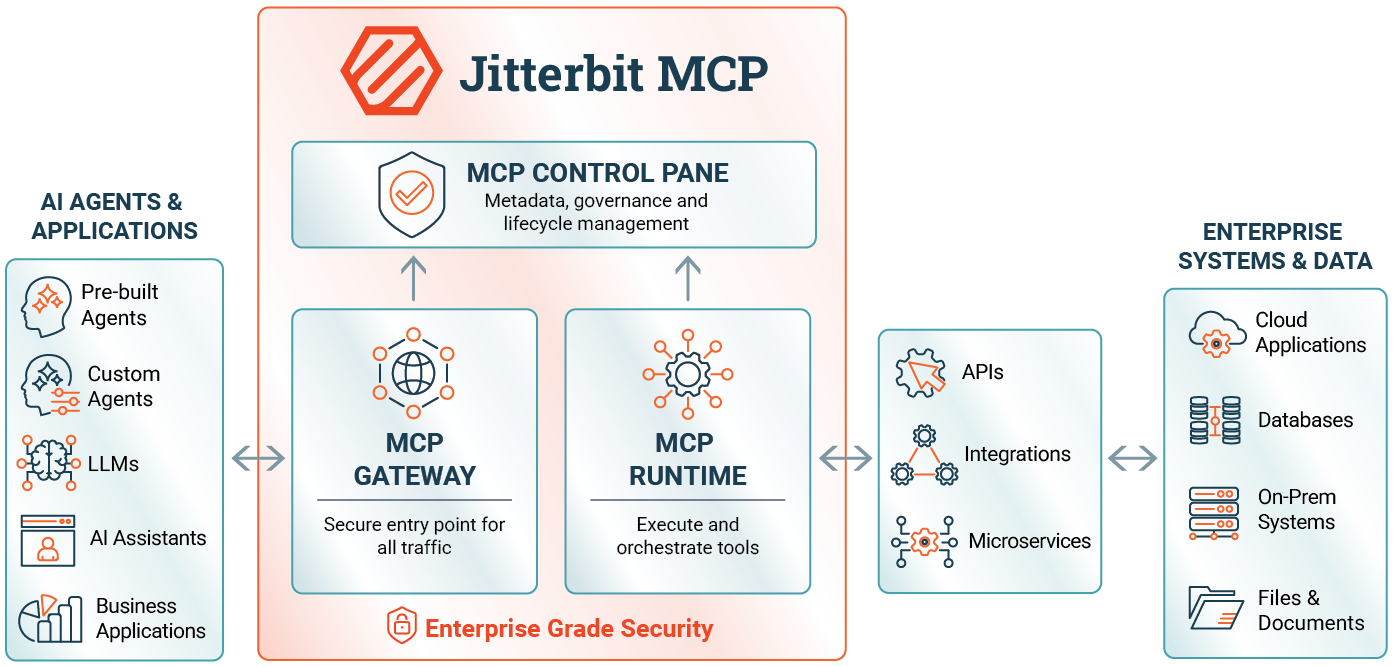
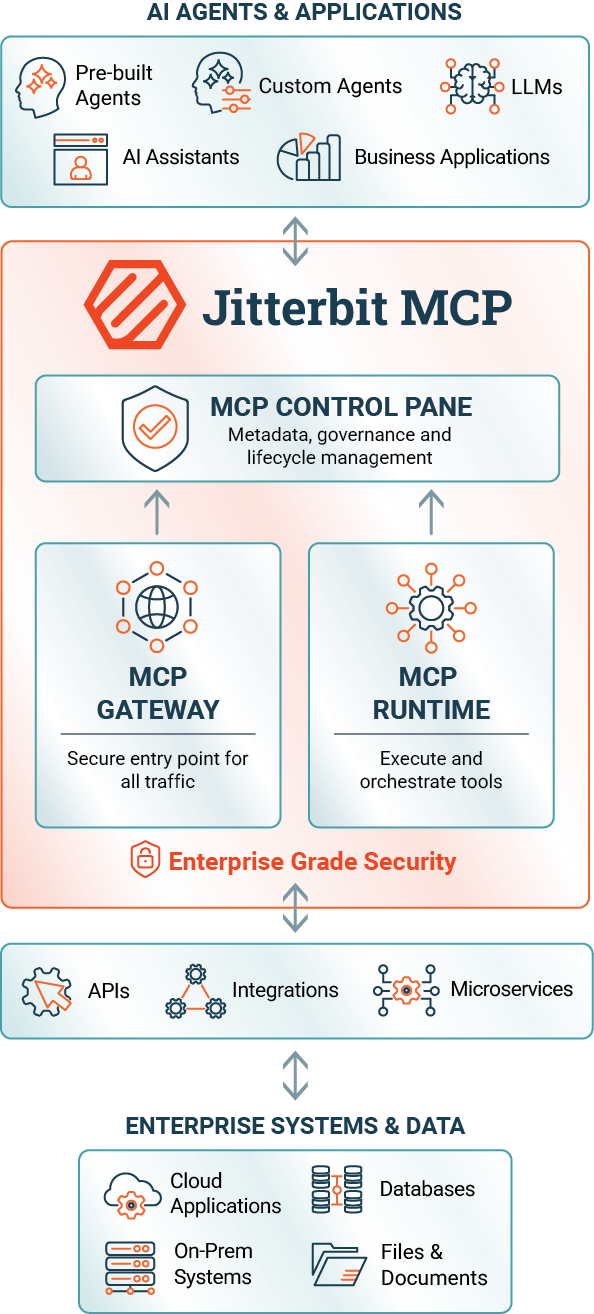
Jitterbit MCP combines three core capabilities into one unified solution.
1. MCP Gateway
The secure entry point for AI traffic. It provides:
- Access control
- Policy enforcement
- Rate limiting
- Traffic governance
2. MCP Runtime
The execution layer that transforms enterprise capabilities into agent-ready tools. It enables agents to use:
- APIs
- Integrations
- Data resources
- Reusable prompts
3. MCP Control Plane
The governance and lifecycle layer. It manages:
- MCP servers and tool catalogs
- Identity and permissions
- Policies and controls
- Lifecycle management
- Monitoring and audit trails
Together, these components help enterprises operationalize AI with confidence.
Built on the Harmony Platform
The fastest path to enterprise AI is not rebuilding from scratch. It is reusing what already works.
Jitterbit MCP is built into the Jitterbit Harmony platform, allowing organizations to immediately leverage existing investments across:
- Studio for workflows and automation
- API Manager for governed APIs
- App Builder for business applications
- EDI for B2B transactions and partner connectivity
- Marketplace for prebuilt AI agents, integration workflows and reusable solutions
This means enterprises can rapidly expose existing business capabilities to AI agents without rebuilding what they already own.
Real Business Use Cases
AI value is realized when intelligent systems can act across real business processes. Here are examples of where MCP can deliver immediate impact.