 Jitterbit iPaaS
 Jitterbit EDI
 Jitterbit API Manager
 Jitterbit MCP
 Jitterbit App Builder
 Marketplace
 Management Console
 Cloud Datastore
 Message Queue
 Jitterbit AI

As organizations increase their investments in AI, they’re also introducing complexity. Departments often deploy multiple AI agents, tools, and models independently, each with its own logic, data sources, and objectives. This decentralized approach can lead to what’s called AI agent sprawl, which is the unchecked growth of autonomous systems operating without centralized oversight. Or, simply put, too many disconnected AI tools that become difficult to manage.
Rather than boosting productivity, agent sprawl introduces new risks, such as duplicated efforts, inconsistent data handling, and security blind spots. These agents often run in siloed environments without proper integration into existing infrastructure, creating more complexity rather than less.
AI orchestration addresses these challenges by acting as the connective tissue between disparate AI components. It provides the centralized control needed to coordinate how agents interact, manage data flows, and ensure that every part of the system operates securely and efficiently.
What is AI orchestration?
AI orchestration is the process of managing and coordinating different AI systems and tools across an organization. It enables AI components (like large language models [LLMs], machine learning algorithms, data pipelines, and autonomous agents) to work in sync and follow business logic to scale effectively.
Think of orchestration as the “control layer” for AI. It defines how data flows between systems, how decisions are triggered, and how responses are executed. It allows businesses to automate and manage complex AI workflows with minimal human intervention, while still maintaining oversight and governance.
AI orchestration vs. AI integration
While AI integration is about connecting systems, AI orchestration is about managing how those systems work together in context.
Simply put, integration is foundational—orchestration is strategic.
AI Integration ensures your LLMs, CRMs, and databases can talk to each other. AI Orchestration defines when and how those tools collaborate to solve real problems.
Benefits of AI orchestration
An orchestration platform solves these problems by centralizing logic, data flow, and governance across AI models.
AI orchestration helps enterprises:
- Unify disconnected AI efforts into a single strategy
- Improve system performance and reduce redundancy
- Enforce security and governance across AI workloads
- Streamline data movement across internal and external sources
- Operationalize AI across the organization with confidence
Without orchestration, AI systems can’t scale, stay secure or deliver the insights and automation businesses need.
What does AI orchestration look like in practice?
A well-designed AI orchestration layer brings together the following capabilities:
1. Workflow automation across AI systems
AI orchestration coordinates the sequence of tasks between agents and applications. For example, a customer support AI workflow might start with a language model summarizing an issue, then route the result to a ticketing system, and finally trigger a human-in-the-loop escalation if needed.
2. Real-time data integration
Effective orchestration pulls in data from multiple systems (CRMs, ERPs, data warehouses, etc.) and ensures it’s validated and routed to the right AI systems. This enables real-time decision-making without duplicating effort or introducing inconsistencies.
3. Agent and model management
As businesses deploy more autonomous agents, orchestration ensures they don’t conflict with one another, duplicate tasks or go unchecked. It provides centralized visibility into agent behavior, ensuring coordination across teams and functions.
4. Governance and security
AI orchestration platforms enforce access controls, data masking and compliance policies across all components, ensuring the secure handling of sensitive data and preventing unauthorized access to AI models.
5. Scalability and resource optimization
By managing when and how AI components are triggered, orchestration helps organizations optimize cloud usage and reduce latency. It also helps ensure high-priority tasks receive the resources they need.
Managing AI agent sprawl
Since AI initiatives are now considered standard for business processes, many companies are beginning to face AI agent sprawl. This occurs when siloed teams build independent agents using different models and frameworks, resulting in a tangled, unmanageable network of AI tools that leads to interoperability and visibility issues. This fragmentation slows progress and introduces new operational and security risks, while also contributing to duplication of effort and wasted cloud resources.
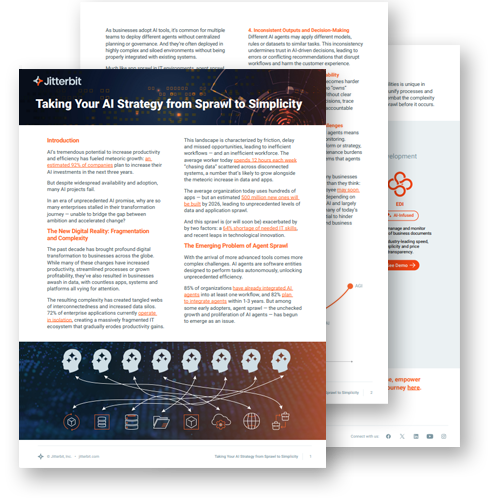 Learn more about preventing AI agent sprawl in Jitterbit’s free ebook: Taking Your AI Strategy from Sprawl to Simplicity
Get the Ebook
Future-proof your AI strategy with Jitterbit Harmony
Jitterbit Harmony is a low-code, AI-infused platform built to unify integration, automation and agent development across all systems, from cloud to on-prem to legacy infrastructure.
With prebuilt connectors for OpenAI, Azure AI and Amazon Bedrock — as well as robust security frameworks based on NIST and CISA standards, and native support for MCP (the emerging standard for agent connectivity) — Harmony helps you build AI solutions that are not only powerful but also accountable, secure and scalable.
To learn more about how Jitterbit Harmony can help you implement and manage a scalable AI strategy, schedule a demo with a product expert or explore our self-guided demos.