 Jitterbit iPaaS
 Jitterbit EDI
 Jitterbit API Manager
 Jitterbit MCP
 Jitterbit App Builder
 Marketplace
 Management Console
 Cloud Datastore
 Message Queue
 Jitterbit AI

A supplier misses a Walmart ASN window by two hours. The chargeback hits before anyone notices. By the end of the quarter, a series of small EDI failures like these can cost a business hundreds of thousands of dollars in penalties, strain key retail relationships, and consume weeks of IT time chasing down root causes.
This is not a hypothetical—it plays out across supply chains every day, and it is almost always preventable with the right EDI solution in place.
Whether you’re implementing EDI for the first time or replacing an existing solution that no longer meets your needs, choosing an EDI vendor is a long-term decision that touches nearly every part of your business, from how you onboard trading partners to how orders flow through your ERP. In this guide, we’ll go over key factors to look for in an EDI solution and what questions you should be asking to get the answers that actually matter for your operations.
EDI is a Growth Market, Not a Legacy One
EDI has powered global commerce for decades, and it’s not going anywhere. Eighty-five percent of supply chain transactions are still managed through EDI, and EDI accounts for over $7 trillion in sales transaction value each year. If your business trades with major retailers, operates across supply chains, or handles high volumes of B2B transactions, you either already rely on EDI or will soon need to.
Despite its widespread use, a common misconception is that EDI is old technology on its way out. The data tells a different story:
- The global EDI software market is projected to grow from roughly $2.1 billion in 2024 to more than $5.3 billion by 2032—a compound annual growth rate of 12.6%, on par with categories like cloud infrastructure and cybersecurity
- 77% of midmarket companies increased their EDI and B2B integration investments in 2025
Several factors have accelerated the growth of the EDI market in recent years—cloud adoption, for one, has made EDI more accessible to smaller businesses. AI and machine learning are also creating new opportunities for automated mapping, anomaly detection, and workflow optimization within EDI platforms, improving their efficiency.
5 Factors to Consider When Choosing an EDI Provider
Choosing an EDI provider requires considering both technical capabilities and long-term business alignment. These are the key factors to assess:
1. Trading partner compatibility
Each trading partner brings its own EDI standards, document versions, communication
protocols, and business rules. Even partners using the same X12 standard often have unique mandatory fields and formatting requirements. Managing this complexity is where many EDI implementations struggle.
Look for platforms that offer pre-built trading partner connections to reduce implementation and onboarding time. For larger businesses in need of assistance, look for an EDI vendor that also provides dedicated support for trading partner onboarding.
2. Integration capabilities
An EDI solution’s integration capabilities are among the most important factors to consider, and the one most frequently underestimated. Your EDI solution must connect to your ERP (SAP, Oracle, NetSuite, Microsoft Dynamics 365, Sage), your ecommerce platform (Shopify, Magento, BigCommerce), your warehouse management system, CRM, and any other business applications in your stack. If it can’t, you’ll end up with a data silo that creates new manual work rather than eliminating it.
3. Visibility and error handling
An EDI platform should alert you to problems before they impact your trading partners. Features like real-time transaction monitoring, proactive alerts for failures and compliance issues, and transparent audit trails provide the visibility needed to address errors quickly.
4. Security and compliance
At minimum, look for EDI solutions that offer:
- SOC 2 Type II certification
- Data encryption in transit and at rest
- Granular access controls
- Documented disaster recovery plans
Healthcare organizations will also want to look for EDI solutions that are HIPAA compliant. HIPAA mandates standardized electronic transactions using X12N, with non-compliance penalties ranging from $100 to $50,000 per violation.
5. Predictable pricing
EDI pricing models vary widely: per-transaction, per-partner, monthly subscription, or hybrid. The per-partner model (unlimited messages per partner) tends to offer more predictable costs than per-message pricing, which creates surprise billing spikes during high-volume periods.
Watch for hidden fees: setup costs, VAN fees, per-character limits, mapping fees, and auto-renewing contracts. Always calculate total cost of ownership, including setup, customization, training, and ongoing maintenance.
20 Questions to Ask a Potential EDI Vendor
Choosing the right EDI provider protects supply chain continuity and strengthens trading partner relationships. Refer to this list during vendor evaluations to surface hidden gaps:
Architecture & Technology
- Is your platform cloud-native and API-first?
- What communication protocols do you support? (AS2, SFTP, FTP, VAN, API, HTTPS)
- Do you own your own EDI translators, or rely on third-party tools?
- Can we see a demo of the full process (from setup to mapping to data flowing into our ERP)?
Trading Partner Onboarding
- How many pre-built trading partner connections and maps do you maintain?
- How fast can we onboard a new partner end-to-end?
- Who manages mapping changes when a retailer updates their specs, and how quickly does that happen?
Integration
- What pre-built connectors do you offer for SAP, Oracle, NetSuite, Dynamics 365?
- Can your platform connect EDI with our ecommerce platform, CRM, WMS, and other systems?
Visibility & Error Handling
- Do you provide real-time transaction monitoring dashboards?
- What proactive alerts exist for errors, rejections, and failures?
- Can we search, repair, and resend documents directly from the interface?
Scalability
- What happens to pricing if our transaction volume doubles or triples?
- Can we add trading partners without disruption or repricing surprises?
Security & Compliance
- What certifications do you hold? (ex. SOC 2 Type II, HIPAA, ISO)
- How is data encrypted in transit and at rest?
- Do you maintain full audit trails for all transactions?
Pricing & Contracts
- What is your pricing model (per-transaction, per-partner, flat rate)?
- Are there any additional fees: setup, mapping, VAN, character limits, overages?
- Do you require long-term contracts or offer month-to-month flexibility?
Why the Platform Model is the Future of EDI
Most EDI evaluation guides stop at EDI-specific capabilities. But the most important question is broader: does your EDI solution exist in isolation, or does it connect natively to the rest of your tech stack?
Standalone EDI vendors typically offer EDI as a separate service, often through external portals, creating parallel systems that still require manual effort to move data into ERP, CRM, or ecommerce platforms. Businesses end up needing additional middleware to bridge the gap, adding cost, complexity, and points of failure.
The alternative is a unified platform that combines EDI, integration (iPaaS), API management, and application development in one place. The practical benefits are significant:
- EDI data flows directly and automatically into your ERP, ecommerce platform, CRM, and other systems
- A single vendor relationship means fewer contracts, fewer support escalations, and one team accountable for the full data flow
- Non-EDI integrations (API-based, webhook-based, flat file) are handled on the same platform, eliminating the need for separate middleware tools
- Faster partner onboarding leveraging shared infrastructure and pre-built connectors
Jitterbit Harmony: A Unified Approach to EDI
Jitterbit Harmony is a unified, AI-infused low-code platform that combines iPaaS, API Manager, App Builder, and EDI in a single platform, with proprietary EDI translators built in rather than bolted on via third-party tools.
To support EDI implementation and integration, Jitterbit Harmony:
- Supports ANSI X12, EDIFACT, XCBL, TRADACOMS, and HL7, as well as AS2, FTP/SFTP, and VAN connectivity
- Offers over 1,000 pre-built trading partner connections
- A single dashboard that provides full visibility into transactions, documents and trading partners
- Provides a user-friendly, self-service interface for adding and managing partners without vendor requests
- Complies with a wide range of industry-specific regulations and standards, including CCPA, GDRP, HIPAA, AICPA SOC 1, SOC 2, and SOC 3 Type 2 compliance, ISO 27001:2022, and ISO 42001:2023 AI certification
- Leverages AI to accelerate the development, management and maintenance of B2B transactions
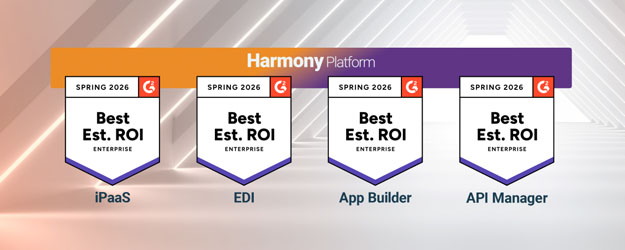
Jitterbit EDI has a proven track record of saving businesses time and money, with robust support that allows businesses to see faster results:
| METRIC | JITTERBIT EDI | INDUSTRY AVERAGE |
| Estimated time to ROI | 11.44 months | 12.64 months |
| Time to go-live | 2.44 months | 3.02 months |
 Learn More:
Ready to Start Evaluating Your Options? Schedule a Platform Demo
Choosing an EDI solution is a long-term decision that touches nearly every part of your business, from how you onboard trading partners to how orders flow through your ERP. If you’d like to see how a unified integration and EDI platform could work for your specific trading partner network and tech stack, our product experts will walk you through a live demo of Jitterbit Harmony tailored to your industry and use case—contact us today to get started.