 Jitterbit iPaaS
 Jitterbit EDI
 Jitterbit API Manager
 Jitterbit MCP
 Jitterbit App Builder
 Marketplace
 Management Console
 Cloud Datastore
 Message Queue
 Jitterbit AI
Originally published March 27, 2024; updated May 18, 2026
The current economic environment demands that companies deliver exceptional customer experiences throughout the customer lifecycle. Fifty-nine percent of consumers say that they now place more importance on the customer experience when choosing the brand from which to buy.1
Enterprise Resource Planning (ERP) systems play a critical role in providing the data needed to deliver those customer experiences. Traditionally used as back-office systems handling accounting and financial information, ERPs must now connect with customer-facing systems such as Customer Relationship Management (CRM), ecommerce, customer service, and many others to enable a seamless customer journey.
Companies need a modern approach to ERP system integration that overcomes challenges and puts them on the path to delivering exceptional customer experiences.
What is an Enterprise Resource Planning (ERP) System?
An enterprise resource planning (ERP) system is a business management software that helps automate a company’s essential business functions. For many organizations, an ERP is the system of record that collects inputs from departments across the organization – including accounting, manufacturing, supply chain, sales, marketing, and more – to ensure there is a single source of truth for its data.
The term “ERP system” is often used synonymously with “financial system” (accounting, invoicing, financial reporting). Eighty-nine percent of the respondents in a survey considered accounting the most critical ERP function,2 but vendors with integrated business software also offer many other modules – such as business intelligence (BI), customer relationship management (CRM), omnichannel commerce, material requirements planning (MRP), supply chain management (SCM), and human resource management (HRM).
Since an ERP system handles many customer-facing activities like orders, billing, fulfillment, and shipping, creating exceptional customer experiences requires ERP integration connecting to other applications and data sources a business uses.
What is ERP integration?
Simply put, ERP integration connects and synchronizes ERP software to other applications and data sources. It gives you a unified view of information from different systems in real time, whether the data originates in the ERP or other systems. The importance of ERP integration is that it increases the efficiency of business processes, business operations and workflows, as well as increases collaboration between teams.
Challenges faced without ERP integration
In today’s current economic climate, if your company does not have an ERP system integration, you face numerous challenges that stifle your ability to compete.
Data Silos
Data silos prevent companies from getting the most out of their systems. ERP systems that were implemented years ago might sit in legacy and on-premises data silos, while newer applications reside in the cloud. Disparate data silos lead to redundancy, inefficiency, and inaccurate data.
Slow Manual Processes
Without ERP system integration, you rely on manual processes to move information between the ERP and other systems. For example, when a customer places an order, it goes into a CRM. If the order must be manually entered into the ERP system, the workforce’s burden increases, and operational efficiency is hampered. The workforce required to do the manual processes are prevented from performing higher value work.
Lack of Real-Time and Accurate Data
Disconnected systems mean manual data entry and updates, which create a delay in information exchange across the customer experience and lifecycle. While manually processing a new customer order, the rest of the company does not have access to the order in real time.
Manufacturing might build inventory for a different product than what was ordered, leading to discrepancies in inventory management. The customer will not receive the status of the order. Accounting won’t send an invoice to the customer or book revenue. Everything waits until the order undergoes manual data entry.
Inability to Achieve Strategic Customer Experience Initiatives
Integration is imperative if businesses are to deliver on customer experience initiatives. An ERP system contains crucial financial, product, fulfillment, and other customer-related information. Without an integrated view of customers, companies like Amazon could not make in-the-moment recommendations on products to buy or give real-time status when the product arrives at your door.
Some companies have custom built integrations in the past, which tended to be point-to-point integrations with no reusable code. These ERP integrations require changes or replacement to extend them to add special features or to connect more systems. Companies cannot achieve their strategic customer experience initiatives until legacy custom-coded integrations are made extensible.
Examples of ERP software integration
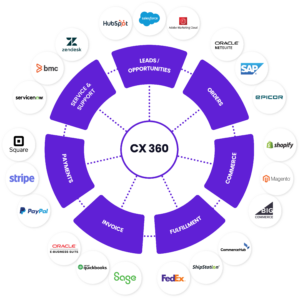
The role of ERP systems in system integration is crucial as they hold product, sales order, and customer data. The types of ERP integration that optimize business workflows are numerous; here are a few key ones to consider:
CRM-ERP Integration: Connecting Demand with Supply Chain
Sales focus on increasing revenue by acquiring, satisfying, upselling, and cross-selling customers. The CRM system holds the customer contact and interaction information, but CRM must integrate ERP for order management, fulfillment, and shipping.
The CRM with the largest market share is Salesforce Sales Cloud, but there are many others, including Adobe, Microsoft Dynamics, SAP, and SugarCRM. Some ERP integrations and systems include CRM modules.
Ecommerce-ERP Integration: Making Front-End Data Available
The COVID-19 pandemic accelerated the move to ecommerce as companies were forced to shift from in-person to contactless sales and services overnight. Ecommerce platforms provide customer browsing, ordering, and payment capabilities and are often the first contact with the customer.
The ecommerce platform’s success hinges on seamless ERP integration to manage the order fulfillment process — checking or updating inventory and shipping the product.
There are many ecommerce platforms, including Amazon, BigCommerce, Magento, Shopify, and others.
ERP-ERP Integration: Ensuring Accurate Financial Data
Companies may have multiple ERP systems, whether due to acquisitions, mergers, or departmental preferences. These ERP systems need to be connected to each other to create a consistent and accurate view of customer and product data.
The ERP systems used by many companies include Epicor, Microsoft Dynamics 365, Oracle NetSuite, SAP S/4 HANA, Sage, Workday Financials, and others.
Customer Service-ERP Integration: Tracking Support via Customer Service Systems
Excellent customer service boosts customer satisfaction, reduces churn, and responds to customer needs faster and intelligently. A broad range of applications handle customer service, support, and field service. Customer service software handles omnichannel capabilities, self-service capabilities, and proactive interactions through predictive analytics and AI.
Customer support software, often called IT Service Management (ITSM), manages IT desk and incident request management. Field service software manages warranty and contracts, returns and repairs, maintenance, and scheduling field service work. To ensure seamless customer interactions, companies must prioritize ERP integration by seamlessly integrating all these customer service applications.
Popular customer service platforms include BMC, Cherwell, Jira, Salesforce Service Cloud, Oracle Service, ServiceNow, ServiceMax, Zendesk, and others.
What are the benefits of ERP integration?
ERP system integration enables companies to make the most of their data and deliver exceptional customer experiences. Here are the specific benefits of ERP integration companies gain.
-
Drive Greater Efficiencies
Processing orders can be slowed down by the fact that sales-related documents are scattered in multiple repositories. By automating the business processes to pull documents together from different systems, manufacturers can reduce bottlenecks in the order-to-cash workstream, and reduce time delays in the fulfillment, delivery, and invoicing process.
Access to all customer and product information in one digital workflow reduces bottlenecks in order-to-cash and improves order turnaround time.
-
Personalize Customer Experiences
ERP integration helps your company get intelligent insights on what a customer needs or might want. If you can access all that data sitting in the back-office, you can create uniquely tailored offerings for your customers. But the right technology is needed to combine this data with additional online, offline, and third-party sources to create a single, dynamic customer profile. Then you can use this single view of the customer and apply AI to recommend best-fit messaging and offers across all your digital commerce interactions.
-
Optimize the Value Chain
Integration makes better use of data throughout your company’s value chain. A complete view of customer data enables manufacturers to better predict customer demand, quickly adjust to changes in the marketplace, accelerate the engineer-to-order process, and communicate more effectively.
Explore Jitterbit’s low-code integration platform for ERP integration
ERP integration methods
There are several ways to integrate ERP systems, each with different benefits and trade-offs:
Point-to-point integration
Point-to-point integration links ERP modules or external systems directly. While it works for simple connections—like syncing a single module to a CRM—it becomes hard to manage as ERPs often involve dozens of interconnected systems and data flows.
ESB (Enterprise Service Bus)
An ESB centralizes communication between ERP systems and other applications, standardizing data exchange across modules. It handles more complex ERP workflows but often requires significant infrastructure, ongoing maintenance, and specialized IT expertise.
iPaaS (Integration Platform as a Service)
iPaaS is a cloud-based solution designed for ERP integration at scale. It offers pre-built ERP connectors, reusable templates, and visual tools to automate processes across finance, supply chain, HR, and CRM modules. iPaaS reduces IT overhead, simplifies multi-system workflows, and accelerates ERP-driven business processes—making it the most flexible, scalable, and cost-effective choice for modern ERP ecosystems.
Why choose Jitterbit for ERP integration?
Jitterbit Harmony combines ease-of-use for common integrations with the flexibility to handle complex ERP workflows. Built on our industry-leading iPaaS platform and informed by thousands of successful customer integrations, Harmony accelerates your ERP initiatives with the following capabilities:
Single Platform for Integration
Based on Jitterbit’s API integration platform, which has robust capabilities to design, templatize, deploy, and manage integrations.
Pre-Built Integrations and Process Templates
Accelerate your business with pre-built connectors, integrations, and process templates that let you connect systems, move data, and automate processes instantly—no custom coding required.
Visual Interface for Customizing Complex Integrations
Jitterbit’s drag-and-drop interface lets you customize complex integrations with minimal IT effort, combining pre-built components and reusable, extensible logic for scalable automation.
API Management
API Management enables a company to create, run, secure, manage, and analyze all APIs and microservices using a single platform. APIs can access any application or data source, either in the cloud or behind the firewall, at any time.
Get started today with our ERP integration solution!
Schedule a demo today
ERP Integration FAQs
How long does it take to implement ERP integrations?
Implementation time varies based on the complexity of your ERP, the number of systems being connected, and the integration method. Simple integrations can take a few weeks, while complex, multi-system ERP integrations may take several months. Using pre-built connectors provided by an iPaaS platform can significantly shorten deployment time.
What business processes can be automated through ERP integration?
ERP integration can automate a wide range of processes across finance, HR, supply chain, and sales, including order-to-cash, procure-to-pay, inventory updates, employee onboarding, and reporting workflows. Essentially, any repetitive process that involves data moving between systems can be streamlined and automated.
Will connecting other systems to my ERP compromise security?
When done properly, ERP integration does not compromise security. Modern integration platforms like iPaaS provide secure, encrypted data transfers, robust access controls, and compliance with industry standards, ensuring your ERP data remains protected while enabling safe connectivity across applications.