 Jitterbit iPaaS
 Jitterbit EDI
 Jitterbit API Manager
 Jitterbit MCP
 Jitterbit App Builder
 Marketplace
 Management Console
 Cloud Datastore
 Message Queue
 Jitterbit AI
By Amber Wolff, Content Manager
Traditional integration tends to be complex, time-consuming and dependent on specialized expertise:
“I was spending up to 20 hours a week in addition to my day job after hours, handholding, restarting the system, and doing what I needed to do to keep the integrations working.”
“With custom integrations, we had to hunt down the code, find the developers, understand that code, make the changes and redeploy any time we wanted to debug or make minor changes.”
“Our legacy systems involved many point-to-point integrations, which required regular custom developments. There were heavy dependencies on specific developers or teams with specialized knowledge of those point-to-point integrations.”
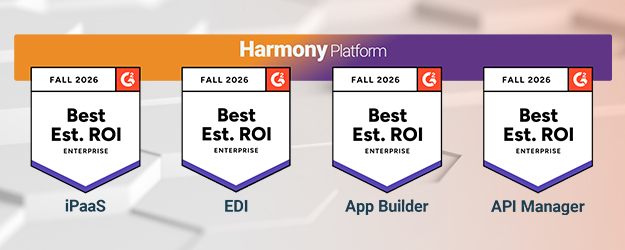
For these enterprises and countless others like them, Jitterbit iPaaS was a game changer. We’ve spent more than a decade empowering businesses to build more scalable and reliable integrations without needing a team of specialists or expensive contractors. It’s why users consistently give us top marks, and why third-party evaluators like G2 repeatedly note that we deliver the best estimated ROI and the highest user adoption (73%, vs. 54% industry average).
But while iPaaS integration can reduce errors, streamline manual processes and solve countless other problems, it can’t do anything if developers are too busy to build the integrations in the first place.
Beating the Bottleneck
IT used to be simple: Set up the new employee’s workstation, head out to Best Buy to pick up the latest version of Windows, call the printer repair company (again.) But today’s IT teams are dealing with a dramatically expanded slate of responsibilities, from remote and hybrid workforces to shadow AI.
At the same time, the number of apps continues to explode, with nearly 9 million apps on the market and many more proprietary, custom or in-house apps that also need to be integrated. What’s more, these integrations are no longer just productivity boosters — for businesses looking to expand their agentic environment, they’re critical to the functioning of AI agents.
This confluence of IT workloads and ever-increasing integration demands often leads to bottlenecks, where even critical integration projects are stalled in the queue. All the while, line-of-business users are stuck with error-prone manual processes and AI agents can’t access the data they need to do their jobs.
So how do you beat the bottleneck? Traditionally, it required additional IT staff, but that expertise comes at a hefty price, particularly when you’re competing against countless other companies trying to get rid of backlogs of their own. With Jitterbit iPaaS AI Assistant, you can grow your integrator pool without needing to hire additional resources, putting the power to create integrations into the hands of those who will use them.
Welcome to the Era of the Citizen Integrator
Jitterbit iPaaS AI Assistant makes it possible to design, build, test and deploy integrations using a prompt-based, conversational interface. This expands the integration pool from developers and other technical staff to even the most nontechnical line-of-business users — in other words, if you can type, you can integrate.
Users simply open a chat window, then describe the integration requirements in plain English. Then the AI assistant translates that intent into executable integration logic, automatically generating APIs, workflows, data mappings, queries, variables and orchestration steps.
It’s Easier for Expert Users, Too
The iPaaS AI Assistant isn’t just for beginners. Developers accustomed to dealing with lots of manual configuration and scripting will find that the assistant greatly reduces their development time and simplifies complex workflows.
With full integration lifecycle support — design, build, test, deploy and run — the assistant can generate workflows in minutes, not days. And giving IT staff the ability to generate complete integration logic, including connections, queries, variables and transformations, can help reduce their ticket backlog in record time.
Seamless Orchestration Via Jitterbit Studio
Unlike standalone AI tools, the iPaaS AI Assistant is fully embedded within Jitterbit Studio. This allows end-to-end lifecycle automation — from design through deployment and operations — within a single AI-powered experience for greater efficiency and reliability.
The AI assistant uses natural language to generate integrations that connect applications, APIs and data to enable coordinated, end-to-end workflows—while leveraging context from existing integrations, data structures and platform components to intelligently extend and refine those workflows.
All with Jitterbit Security and Governance
Best of all, the Jitterbit iPaaS AI Assistant does all this while maintaining enterprise-grade control and scalability.
Jitterbit was the first company in the automation, integration and low-code app development industry to achieve a ISO 42001:2023 certification, highlighting our commitment to AI that is designed, developed, and deployed responsibly across the full automation lifecycle.
The company’s focus on AI accountability is central to its layered AI architecture, which provides ‘checks and balances’ and human oversight to mitigate issues like toxicity and AI hallucination in agents. It also builds upon Jitterbit’s existing security-first approach, which includes a layered security foundation and a hybrid framework based on NIST, CISA, CSA and CERT recommendations.