
 Jitterbit iPaaS
 Jitterbit EDI
 Jitterbit API Manager
 Jitterbit MCP
 Jitterbit App Builder
 Marketplace
 Management Console
 Cloud Datastore
 Message Queue
 Jitterbit AI

By Maneeza Malik, Product Marketing Director
Small and midsize businesses (SMBs) have always competed against larger organizations with more resources. Today, that challenge is even greater: customers expect fast, personalized experiences regardless of a company’s size, forcing SMBs to deliver enterprise-level service with lean teams and tighter budgets.
But agentic AI is changing what’s possible for SMBs. Unlike traditional AI tools that primarily respond to prompts, AI agents can reason, make recommendations, take action and automate multi-step workflows. By reducing repetitive work and streamlining operations, SMBs can improve productivity, control costs, and give employees more time to focus on customers, innovation and business growth.
The shift is already underway. According to Gartner, 40% of enterprise applications will include task-specific AI agents by the end of 2026, up from less than 5% in 2025. While large enterprises are investing heavily in Agentic AI, SMBs have an opportunity to move quickly and realize meaningful business value without the complexity of large-scale IT environments.
The question for SMBs is no longer whether to adopt Agentic AI, it’s how to do it strategically. Organizations that wait risk losing efficiency, responsiveness and competitive advantage.
Why an Agentic AI Strategy Matters for SMBs
For SMBs, adopting agentic AI isn’t about implementing AI for its own sake, it’s about solving real business challenges with limited resources. A thoughtful strategy helps organizations focus on the highest-value opportunities, avoid disconnected AI initiatives and create a foundation for long-term success.
When implemented strategically, agentic AI can help SMBs:
- Improve employee productivity by automating repetitive tasks
- Streamline workflows across teams
- Reduce manual effort and operational costs
- Improve customer responsiveness
- Accelerate decision-making
- Enable employees to focus on higher-value work
How Small Businesses Can Get Real Value from AI Agents
Building an agentic AI strategy isn’t about deploying as many AI agents as possible. It’s about creating a practical foundation that aligns AI investments with business goals and delivers measurable business outcomes.
To realize the full value of agentic AI, SMBs should first focus on a few key fundamentals:
- Build an AI strategy: Align agentic AI initiatives with your business priorities and the outcomes you want to achieve.
- Start with high-value use cases: The greatest value comes from embedding AI into the everyday workflows and applications employees already use. Identify repetitive, time-consuming processes where AI agents can improve productivity, customer experiences or operational efficiency.
- Start small and build on success: Launch a “focused pilot”, measure results and use early wins to guide broader adoption. Essentially, a focused pilot applies agentic AI to a single, high-value workflow, allowing SMBs to validate a real business use case, prove measurable impact with minimal risk, and build the confidence needed to scale successful initiatives.
- Prepare your employees: Equip teams with the knowledge, skills and confidence to work effectively alongside AI and encourage adoption across the organization.
- Scale responsibly: As your AI capabilities mature, establish governance and expand AI agents where they can deliver the greatest business value.
Best Practices for SMBs Getting Started with Agentic AI
The following five best practices will help SMBs build that foundation and accelerate their agentic AI journey.
1. Start with AI Assistants to Build AI Confidence
For many SMBs, AI assistants are the ideal first step toward agentic AI.
AI assistants help employees become comfortable using AI in their daily work while delivering immediate productivity gains. They can summarize information, generate content, analyze data, answer questions and automate routine tasks, freeing employees to focus on higher-value work.
Just as importantly, AI assistants help organizations identify where agentic AI can deliver the greatest business value. As employees adopt AI, SMBs gain insight into which workflows can be automated, where business systems need to be connected and which processes are ready for AI agents.
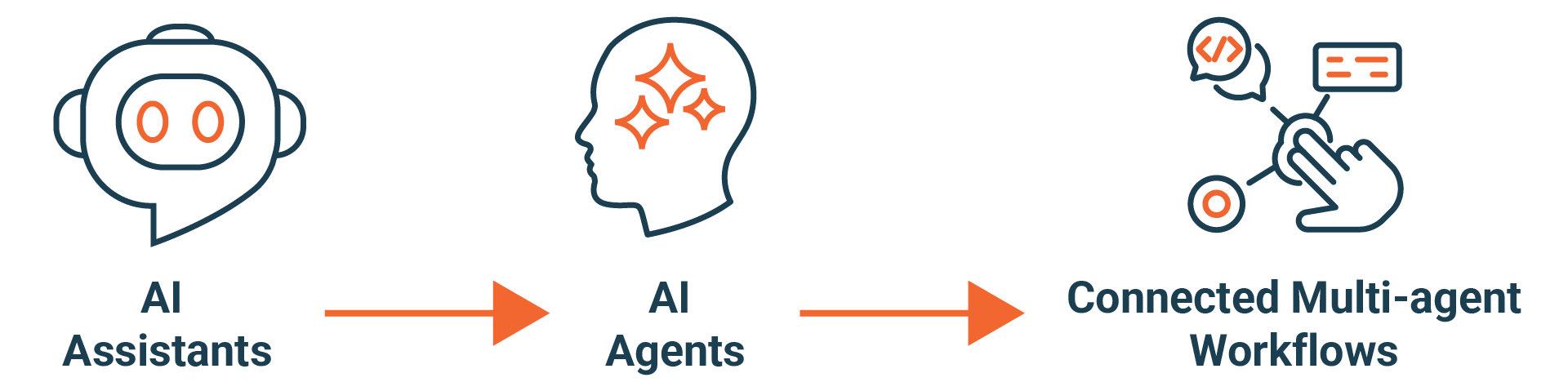
For many organizations, the journey naturally evolves from:
Employee adoption is essential. SMBs should communicate a clear AI strategy, provide training and invest in AI literacy so employees understand how AI enhances their work. Building confidence early creates the foundation for successfully scaling agentic AI across the organization.
2. Prioritize Business Outcomes
Successful agentic AI initiatives begin with business outcomes. Instead of asking where to deploy AI, start by identifying the business challenges that have the greatest impact on productivity, operational efficiency or customer experience.
Ask questions such as:
- Where are employees spending too much time on repetitive, manual work?
- Which processes involve unnecessary handoffs or manual data entry?
- Where do delays negatively impact customers, employees or your business?
- Which workflows require employees to search across multiple systems for information?
Define success before implementation. Whether the goal is reducing processing time, increasing employee productivity, lowering operational costs or improving customer satisfaction, establishing measurable outcomes helps SMBs demonstrate value, build momentum and prioritize future AI investments.
Align business outcomes with practical use cases
Examples of AI agents SMBs can use to improve productivity include:
- Customer support agents that automate customer inquiries and support workflows.
- Sales agents that quality leads, improving sales follow-up and lead management.
- Finance agents that streamline invoice processing by automatically requesting approvals and flagging exceptions.
- HR Agents that automate employee onboarding and offboarding processes.
- Custom, industry-specific agents that automate processes that directly impact business performance, customer experience or employee productivity (e.g., supply chain, pricing, etc.)
Power Finance and Insurance with Accountable Agentic AI
Integrate and orchestrate AI agents, workflows, financial data and systems from a single secure, agentic platform.
3. Build on an AI-Ready Modern iPaaS Foundation
Agentic AI is only as effective as the data, applications and workflows it can access. For SMBs, disconnected systems can prevent AI assistants and AI agents from completing tasks, automating processes and delivering meaningful business value.
To work effectively, AI needs access to:
- Business data and knowledge sources
- Enterprise applications, such as CRM, ERP, HR and IT systems, etc.
- APIs and workflows
An AI-ready Integration Platform as a Service (iPaaS) provides the foundation to connect these systems and enable intelligent automation at scale. It integrates applications, orchestrates workflows and gives AI secure, governed access to the information needed to take action.
With an AI-ready iPaaS, SMBs can:
- Connect applications, data and APIs
- Automate workflows across systems
- Enable AI-driven processes and decision-making
- Scale AI initiatives with security and governance
- Empower people, systems and AI to work together to improve efficiency and business outcomes
4. Establish Governance Early to Scale Effectively
Governance and security should be built into your AI strategy from the start — not treated as an afterthought. As AI becomes more capable and autonomous, strong governance is essential for building trust, managing risk and scaling responsibly.
SMBs should establish clear guidelines around:
- Data security and privacy
- Responsible AI practices
- Regulatory compliance
- Human oversight
- Access controls and permissions
Effective governance provides the guardrails SMBs need to adopt agentic AI with confidence, protect business information and scale AI initiatives responsibly.
5. Think Big. Start Small. Scale Fast.
Successful AI transformation does not happen overnight. SMBs should take an incremental approach, building on early successes, expanding adoption and scaling capabilities as they gain experience and confidence.
SMBs can accelerate their AI journey by leveraging both pre-built and custom AI agents. Pre-built AI agents can help organizations quickly adopt AI capabilities and deliver value faster. As their needs evolve, custom AI agents can address more specialized workflows and create differentiated business capabilities.
A practical scaling approach looks like:
- Start with AI assistants: Build employee confidence, increase AI literacy and create a foundation for broader AI adoption.
- Expand to pre-built AI agents: Automate common business processes and accelerate productivity gains.
- Develop custom AI agents: Address unique business needs and create more tailored, intelligent workflows.
The goal is not to deploy AI everywhere. It is to build a scalable AI foundation that evolves with your business, improves productivity and creates lasting competitive advantage.
Turning Agentic AI into Execution with Jitterbit Harmony
Building a successful agentic AI strategy requires more than AI capabilities alone. SMBs need a foundation that connects their applications, data, workflows and people while providing the security, governance and scalability needed to move from experimentation to execution.
By adhering to comprehensive security protocols, including ISO 42001, Jitterbit Harmony provides that foundation with a unified, AI-infused low-code platform that brings together:
- iPaaS
- Application development
- Full lifecycle API management
- AI assistants and agents
- Model Context Protocol (MCP) capabilities
With Harmony, SMBs can connect systems, automate workflows and orchestrate AI-powered processes across their business from a single platform. Embedded security, governance and observability help organizations scale AI confidently while maintaining control over their data and operations.
Jitterbit enables SMBs to accelerate their agentic AI journey with:
- Jitterbit AI Assistants: Empower employees with conversational AI that guides users, helps build applications, integrations, workflows and APIs. The AI assistants accelerate development and simplify complex tasks, enabling teams to work more productively with AI.
- Jitterbit Pre-Built AI Agents: Automate common business processes and accelerate time to value.
- Jitterbit Custom AI Agents: Enable SMBs to build, deploy and manage custom AI agents in Jitterbit Harmony for unique workflows, specific business process needs and competitive differentiation.
- Jitterbit MCP: Allow AI agents to securely connect with applications, data and tools to deliver more intelligent, connected experiences.
From AI Strategy to Production with Jitterbit Agentic AI Services
Moving AI from strategy to production requires the right expertise, architecture and governance. Jitterbit Agentic AI Services helps SMBs design, deploy and scale secure AI solutions that integrate with existing systems, streamline operations and deliver measurable business value.
With Jitterbit Agentic AI Professional Services, SMBs can design, implement, and optimize secure, scalable AI solutions through:
- MCP-enabled agent integrations
- Retrieval-augmented generation (RAG) workflows
- Human-in-the-loop controls
- Secure agent architectures
- AI governance and operational oversight
Jitterbit combines integration expertise and AI capabilities to help SMBs move from AI strategy to production with confidence.
Ready to Start Your Agentic AI Journey?
See how Jitterbit helps SMBs build, connect and scale agentic AI solutions with AI assistants, AI agents and the integration foundation needed to compete in an AI-driven market.
- Watch the Jitterbit App Builder AI Assistant demo
- See Jitterbit AI in action and learn how AI assistants and agents can transform business workflows
- Discover how Jitterbit’s Pre-Built HR Agent increased efficiency by 100%.
- Unlock faster time to value with Jitterbit Agentic AI Professional Services
- Read 5 Best Practices for AI Governance
- Explore Jitterbit AI Agents: A Complete Guide