
 Jitterbit iPaaS
 Jitterbit EDI
 Jitterbit API Manager
 Jitterbit MCP
 Jitterbit App Builder
 Marketplace
 Management Console
 Cloud Datastore
 Message Queue
 Jitterbit AI
EDI ERP Integration
Jitterbit EDI seamlessly integrates with backend applications like ERP and ecommerce, unlocking transaction-level access to EDI data for your customer service team.
EDI-ERP integration increases efficiency and creates better experiences.
Your relationship with trading partners depends on speed, accuracy, and adhering to their guidelines. Integrating EDI with ERP systems allows seamless, real-time exchange of business documents such as purchase orders, invoices, and shipping notices. This reduces manual data entry, minimizes errors, and accelerates transaction processing.
Potential cost reduction when converting from manual to automatic order processing
Reduction in transactional errors
How Jitterbit’s EDI ERP integration solution works.
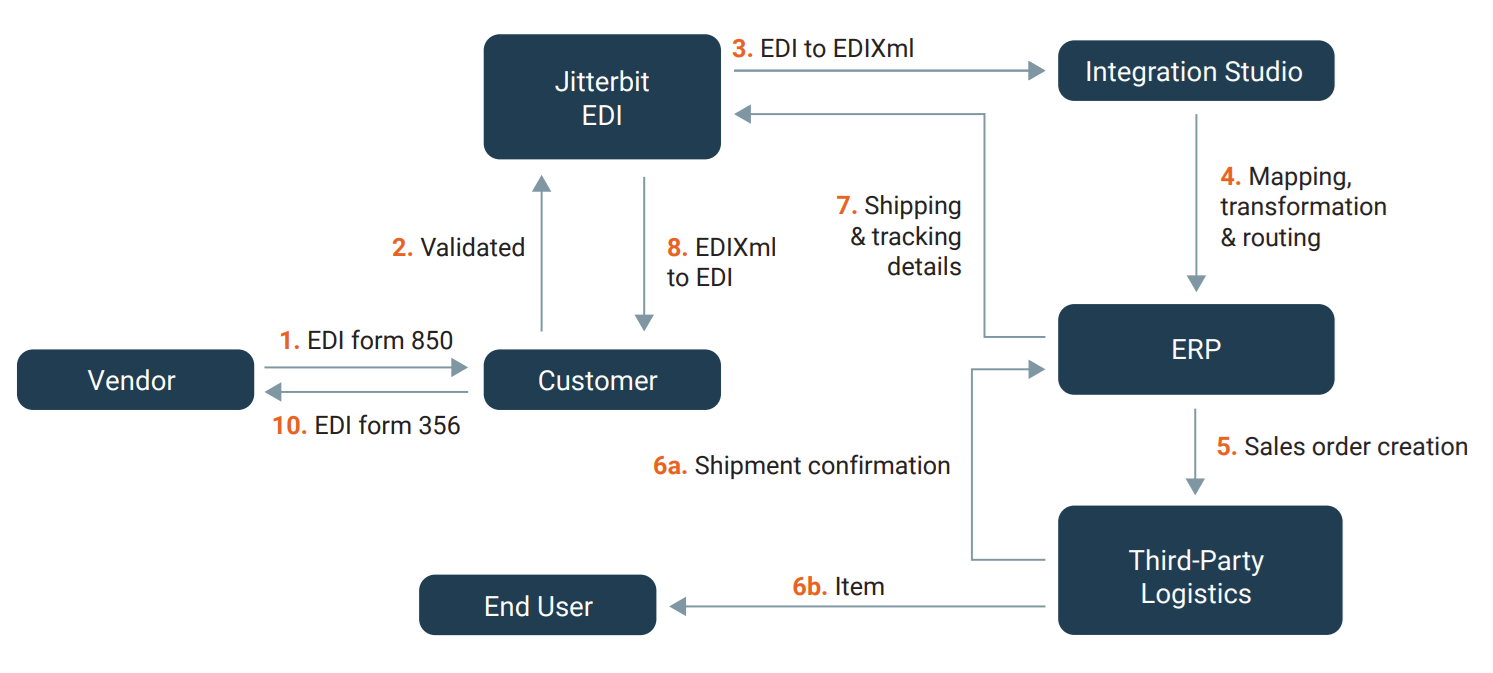
Jitterbit EDI lets you integrate EDI with your entire tech stack, automatically syncing order, fulfillment, and billing data with your ERP system in real time. Here’s how it works:
- Jitterbit EDI receives, validates, and translates an EDI order.
- The XML-based order data is processed through Jitterbit’s Integration Studio, which maps, transforms, and routes the order data into your ERP system.
- A new Sales Order record is created in your ERP system with all relevant order details, including customer information, items, quantities, and delivery preferences.
- The order is routed to a 3PL provider for fulfillment.
- Shipment data is received and updated in the ERP against the original Sales Order, closing the fulfillment loop internally.
- The shipment and tracking details are exported from the ERP and processed again through the Integration Studio, where they are transformed back into EDI documents and sent to the trading partner.
While Jitterbit EDI is designed to be a self-managed solution, we understand not everyone wants to manage setup and deployment on their own. We’re happy to help you connect EDI to your ERP, SCM, CRM, ecommerce, and other back-end systems.
Connect 1,000s of EDI trading partners with leading ERP systems.
Automate data transfers between EDI and ERP systems to improve accuracy and trading partner communications.
























Benefits of integrating EDI and ERP systems.
- Automate data transfers between EDI and ERP systems
- Improve supply chain efficiency
- Eliminate process silos and manual data entry
- Adhere to retailer and partner regulations and protocols
- Ensure critical data is sent accurately and on time
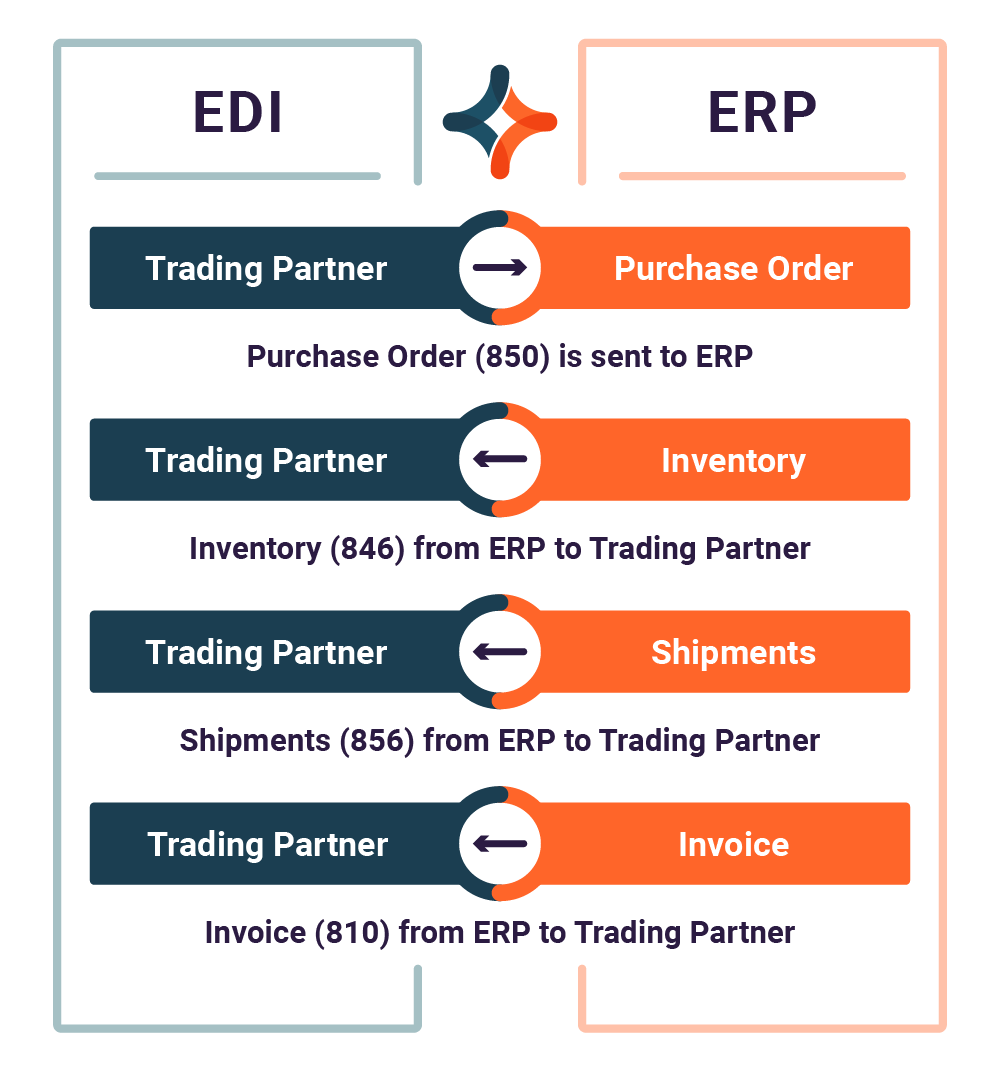
Integration benefits: automate EDI workflows.
Get clarity on what’s happening in every transaction, with complete visibility of EDI data in your ERP system; no manual data entry required.

Increase efficiency
Automate data transfers between EDI documents and your ERP to reduce manual data entry and accelerate transaction processing.

Enhance trading partner communications
Auto-populate EDI data into your ERP system to acknowledge POs and trading partner requests faster.

Improve accuracy and data quality
Automate data flows between systems to eliminate typos, duplication, or other human errors.

Scale easily
Manage and govern integration workflows between EDI and any number of your applications in one place.
Seamlessly connect with top ERPs.








Build and Integrate

Manage your supply chain with EDI
Automate EDI transactions between trading partners and your ERP to gain visibility of communications and documents.
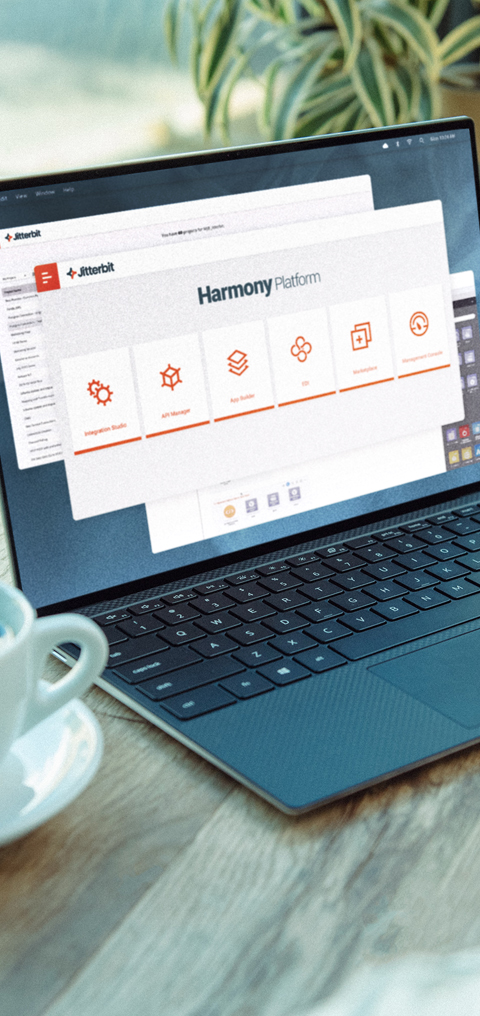
Connect apps with iPaas
Connect SaaS, on-premise and legacy applications with a single iPaaS solution. Automate workflows with an intuitive visual interface. Create and publish developer-friendly APIs.
Related Resources
Learn how EDI powers commerce.



;)
Frequently Asked Questions
What is EDI?
EDI (Electronic Data Interchange) is a standardized method that enables businesses to exchange and process documents electronically between different businesses replacing traditional paper-based documents like invoices and purchase orders. It allows for an accurate, secure, and reliable transmission of data between your systems and with your trading partners so you meet their guidelines.
EDI is a critical piece in driving the supply chain across a multitude of verticals including, but not limited to retail, manufacturing, healthcare, insurance, logistics, distribution, automotive, financial services, and government.
What is an ERP system?
An Enterprise Resource Planning (ERP) system is a software platform that integrates and manages business processes and functions across a business. ERP systems are essential for businesses to manage data across teams such as finance, accounting, human resources, supply chain and inventory teams, manufacturing, sales, and marketing. With an ERP system businesses can access and share data to improve forecasting, collaboration, efficiency, and decision-making. Integrating ERP systems with other applications enhances operational performance and strategic planning.
What is EDI and ERP integration?
EDI to ERP integration involves connecting EDI with Enterprise Resource Planning (ERP) systems, such as NetSuite and Microsoft Dynamics, to facilitate the exchange of data between trading partners. This integration ensures that crucial business documents, like purchase orders and invoices, flow smoothly between the EDI system and the ERP system.
For example, in the case of NetSuite, EDI integration allows for the automatic transfer of sales orders received via EDI directly into NetSuite’s order management system, eliminating manual data entry and reducing errors. This automation reduces the likelihood of errors between the ERP system and external trading partners.
Leveraging iPaaS (Integration Platform as a Service) for EDI to ERP integration simplifies the integration process, reduces costs, and improves operational efficiency, while keeping the relationship and communications between trading partners seamless and without errors.
Why is EDI and ERP integration important?
Marketplaces such as Amazon, Walmart, and Costco use EDI to exchange data because it ensures adherence to their guidelines and protocols. With EDI integration, businesses can automate order, shipping, product, and inventory data from EDI to their ERP systems to eliminate errors caused by manual processes and data entry which ensures accuracy, timeliness, and compliance.
What solutions does Jitterbit offer for EDI and ERP integration?
Jitterbit’s integration platform, Harmony, offers several benefits for businesses transacting with trading partners:
- Gain Visibility: Harmony provides a single source of truth for managing trading partners and EDI transactions, enabling real-time tracking and proactive transaction error identification.
- Scale Easily: Using an integration platform, like Harmony, businesses can add new applications and workflows within their tech stack easily by leveraging pre-built connectors and data mapping tools. This eliminates application disparity when new systems are added to the business.
- Accelerate Integrations: Pre-built connectors for leading ERP systems and CRMs, along with access to thousands of trading partners, enable rapid integration of new applications.
- Automate Workflows: Workflow automation streamlines document exchange, automates tasks, and ensures seamless data flows between trading partners, reducing errors.
- Get Support: Backed by EDI professionals with decades of industry experience, Jitterbit offers high-quality support with rapid response times, ensuring proven performance and peace of mind in B2B integration.