
 Jitterbit iPaaS
 Jitterbit API Manager
 Jitterbit App Builder
 Jitterbit EDI
 Marketplace
 Management Console
 Cloud Datastore
 Message Queue
 Jitterbit AI

By Tomydas Pall, Group Product Manager
A team member asked me recently, “When we enable MCP and it connects everything, why will we even need APIs? Will APIs be gone?”
That question made me pause. At first, it sounded obvious — if MCP connects AI agents to tools and data, maybe APIs aren’t needed anymore. But the more I thought about it, the more I realized the answer isn’t so simple.
To see why, let’s explore this question with a real life example.
APIs: The Foundation of Connectivity
APIs have been the backbone of digital systems for decades. They define how applications talk to each other — fetching data, running actions and powering integrations.
Take an expense management system such as Concur:
POST /expenses/{id}/approve → approve an expense
Without APIs, there’s no way for other systems to reliably interact with this application. APIs are the roads of enterprise software.
Adding the AI Layer
Now, let’s try to add an AI layer to automate these interactions.
Instead of typing commands or clicking through menus, imagine a manager simply asks in Slack:
Or later:
Here’s what happens: The AI agent in Slack interprets the request. It needs to talk to Concur to get data or perform an action. Traditionally, it would hit the Concur APIs directly — but without strong safeguards, that could mean over-permissioning, lack of logging or unsafe automation.
This is exactly where MCP comes in.
Enter MCP: AI-Native Governance
Model Context Protocol (MCP) isn’t here to replace APIs. Instead, it’s the bridge that makes APIs safe, explainable and usable by AI agents.
Here’s how it fits into our example:
The MCP client (running inside Slack with the AI agent) sends the request. The MCP server (sitting close to Concur) wraps the Concur APIs, checking permissions, adding governance and logging actions. Only then does the API call get executed by Concur.
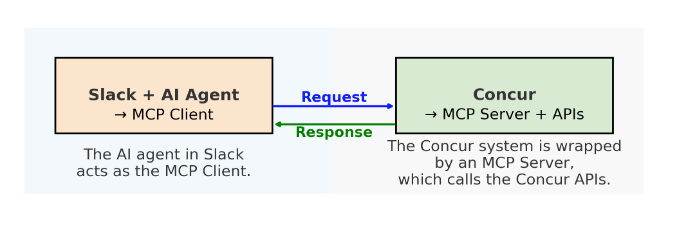
The APIs still do the work – but MCP ensures safe, transparent and governed usage.
Don’t APIs Already Support Governance?
The natural next question usually goes something like this:
“APIs already have OAuth, RBAC, rate limits and audit logs. Isn’t that governance? Why do we need MCP on top?”
Here’s the difference:
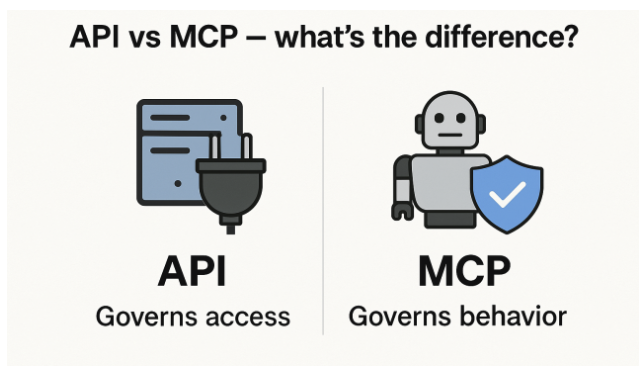
MCP governance is AI-centric. It ensures AI agents interact safely, with guardrails tailored for autonomy, explainability and observability.
In other words, APIs govern access, MCP governs behavior.
That extra layer matters as enterprises shift from human-driven calls to autonomous AI-driven workflows.
MCP in the Real World
MCP is quickly gaining traction, as the following examples show:
- Anthropic’s MCP SDKs → the reference implementation.
- LangChain and LlamaIndex → exploring MCP connectors for their agent frameworks.
- Community MCP Servers → emerging for tools like Jira, Slack, and GitHub.
This signals a trend: enterprises want a standard, safe way for agents to connect to business systems.
API vs MCP: Expense Approval Example
While such connections are certainly possible without MCP, here’s a look at how MCP helps simplify and improve processes:
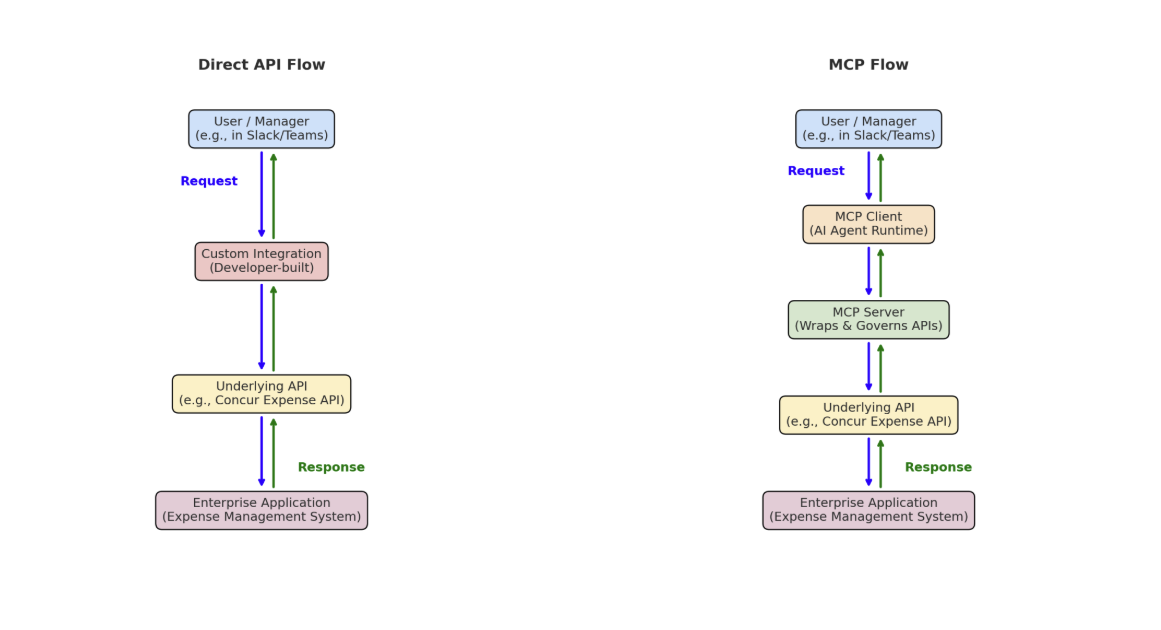
API-Only Flow
- Developer builds a Slack integration.
- Commands directly trigger API calls (GET /expenses, POST /approve).
- This flow works, but it requires custom coding and manual governance.
MCP Flow
- AI agent in Slack connects via MCP Client.
- The MCP client forwards the request to the MCP server, which wraps the Concur APIs.
- The MCP server enforces permissions, logging and context, then calls the API.
- Concur executes the action, returning results to Slack.
- In this flow, the APIs do the work, and MCP makes sure AI agents use them safely.
Emerging Trends Shaping the API vs. MCP Debate
Several forces are converging that will shift the way that enterprises think about APIs and MCP:
Agentic AI Adoption:
As more workflows shift to autonomous agents, governance will move from “user-to-app” rules to “agent-to-app” frameworks.
Standardization Around MCP:
Competing vendors are rallying around MCP as a common way to connect AI models and tools.
AI Observability Platforms:
Dashboards that trace agent decisions, API calls and governance outcomes are becoming enterprise must-haves.
Explainability as Security:
AI interactions will require not just logs, but narratives of why actions were taken.
Shift in API Design:
APIs themselves may evolve to include “agent-friendly” metadata (permissions, safe defaults, risk scoring) built in.
So, Will APIs Disappear?
No. APIs are not going away. In fact, they’re becoming more important, and in the future, we’ll see APIs and MCP co-evolve to support the AI-first enterprise.
MCP adds governance, standardization and observability — but APIs remain the foundation. Think of it like this: MCP is the traffic law and the navigation system that lets AI agents drive safely on API roads.
As agentic AI adoption grows, enterprises will need more APIs, not fewer.
Strategic Takeaways
So where does this leave us?
- APIs remain the foundation. They won’t disappear — they’re still the roads that carry enterprise data and actions.
- MCP makes APIs AI-ready. By governing behavior, not just access, MCP ensures AI agents can interact with APIs safely and transparently.
- Developers should design APIs for the future. If you’re building APIs today, think ahead: How will these APIs be exposed, governed and observed in an AI-first enterprise?
- Expect dual investment. Enterprises will need to strengthen both their API strategies and adopt MCP frameworks for governance.
- Rather than making APIs obsolete, MCP is making them AI-first, helping enterprises use APIs safely in AI-powered workflows.
The Future of AI-Native Connectivity
The next wave of enterprise integration won‘t be about choosing between APIs and MCP. That’s because the real debate isn’t API vs. MCP.
Instead, it’ll be about how quickly organizations evolve to treat APIs and MCP as complementary layers rather than competing choices.
In other words: APIs aren’t going extinct. But enterprises that don’t adapt them for the MCP era might.



;)