 Jitterbit iPaaS
 Jitterbit API Manager
 Jitterbit App Builder
 Jitterbit EDI
 Marketplace
 Management Console
 Cloud Datastore
 Message Queue
 Jitterbit AI
By Amber Wolff, Content Manager
The adoption of AI agents has been nothing short of meteoric, with each new discovery and development dominating headlines and saturating social media. But as with all major technological developments, the truth risks getting lost in the hype. We all know AI agents and automation are great — but what does this development mean for your organization?
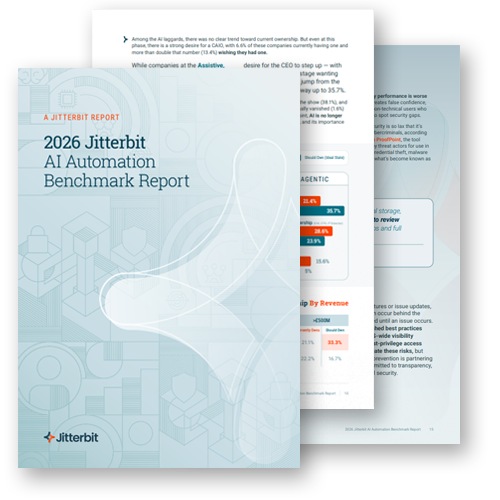
To get a clearer understanding of where everyday businesses are in their agentic transformation journeys, Jitterbit partnered with Censuswide to survey more than 1,500 enterprise IT decision-makers across the U.S., the U.K. and Brazil. We’ve collected these insights in our landmark 2026 Jitterbit AI Automation Benchmark Report. By far our most extensive and comprehensive survey report yet, it highlights the true pace of agent adoption, along with the ongoing challenge companies face in breaking down data silos, integrating with legacy systems, balancing stakeholder expectations and more.
AI Agents Are Virtually Everywhere
While our report reveals five main levels of AI maturity, there were very few true agentic holdouts. And among organizations that had deployed agents, the vast majority didn’t just stop at one or two: The average business now has 28 AI agents deployed.
We also asked respondents about their future plans, and found most businesses are doubling down: The average number of agents expected to be deployed 12 months from now is 40, a 43% increase in adoption.
This number scales with company size: While the largest enterprises surveyed had the most agents currently deployed, they also expect to see the largest jump, going from 49 to 72 in the next year—a 47.5% jump.
It’s important to note that these increases aren’t based on mere speculation: They’re based on real results. More than three-quarters of respondents said their AI automation projects are already delivering moderate to high value. Out of the other 22%, most said they were breaking even: Only 2.5% of businesses reported project failure or a negative ROI.
It’s All About Connections
Without proactive management, data silos multiply over time. Not only does this create hassles for your business, it also holds your AI agents back. Nearly two-thirds of the businesses we surveyed ranked Data Silos, Difficulty Integrating Legacy Systems, or both in their top 3 automation challenges – and these issues appeared again and again across our trove of data.
We also found that the ability to integrate systems, processes and agents was a key determinant of success, both in AI and otherwise. By connecting to external databases, APIs and software ecosystems, businesses at the highest level of AI maturity empowered their agents to access real-time, business specific data, instead of letting them rely solely on the static knowledge that they were trained on. The insights gained from these agents were vastly more relevant, enabling better and more agile decisionmaking and driving greater efficiency and success.
Accountability Counts
But while companies are ramping up their agentic deployments, they’re not doing so carelessly: According to our survey respondents, the Wild West-era of implicit AI trust is well and truly over. Businesses today are now prioritizing factors such as security, auditability, traceability and guardrails over other purchase criteria when selecting new AI tools, with 47% of respondents ranking these factors as a top consideration. AI accountability was even more paramount among those in the software and tech industries, at 61%.
With the possibility of the fully automated, autonomous enterprise now widely accessible, Jitterbit is leading the charge in AI accountability — creating solutions that are explainable by design, interpretable by default, and designed to deliver financial impact.
Learn more about our commitment to AI accountability.
Budget Not a Blocker
Security and compliance was also the number-one factor preventing end-to-end automation, at 39%. But while total cost of ownership was a priority for 38% of small businesses, overall less than 15% of respondents said money is holding them back.
This trend also showed up when we asked respondents about their planned budgets for AI and automation — though there were some surprises there, as well.