 Jitterbit iPaaS
 Jitterbit EDI
 Jitterbit API Manager
 Jitterbit MCP
 Jitterbit App Builder
 Marketplace
 Management Console
 Cloud Datastore
 Message Queue
 Jitterbit AI

La gobernanza moderna de IA agentiva no es solo una aplicación de la gobernanza tradicional de IA a agentes autónomos. Es un modelo operativo completamente nuevo para administrar sistemas de IA que pueden acceder a datos para tomar decisiones y operar en sistemas empresariales con participación humana limitada.
A medida que los agentes de IA se integran en los procesos empresariales centrales, la rendición de cuentas cobra más importancia que la simple velocidad. En una encuesta a 1.501 responsables de la toma de decisiones de TI, el 47% de los encuestados afirmó que la rendición de cuentas de la IA era el factor más importante a la hora de evaluar nuevas herramientas basadas en IA. Entre los encuestados que trabajan en grandes empresas, esa cifra aumentó al 53% por ciento.
El informe message lo deja claro: las organizaciones no solo se preguntan si los agentes de IA pueden funcionar. Quieren saber si los sistemas autónomos de IA pueden funcionar de manera segura y dentro de los controles de gobernanza definidos.
¿Qué es la gobernanza de IA agente?
La gobernanza de IA agentiva es el marco que las organizaciones utilizan para definir, monitorear y controlar cómo operan los agentes de IA en los sistemas empresariales. Un marco sólido de gobernanza de IA agentiva debe definir qué puede hacer cada agente, a qué datos puede acceder, cuándo se requiere aprobación humana, cómo se registran las acciones y cómo responden los equipos cuando el comportamiento del agente crea riesgos.
Esto es crítico porque los agentes de IA hacen más que responder preguntas básicas. Pueden activar flujos de trabajo, actualizar registros, interactuar con clientes, acceder a datos sensibles y coordinarse con otros agentes, lo que desencadena flujos de trabajo posteriores. Sin una gobernanza adecuada, tal autonomía puede crear serios riesgos operativos.
Es la respuesta operativa a una pregunta estratégica: ¿Cómo permite su empresa que un sistema autónomo actúe en su nombre sin perder la capacidad de responder por lo que hace?
Gobernanza de IA Tradicional vs. Gobernanza de IA Agéntica
Dado que los agentes de IA están diseñados para actuar de forma autónoma, requieren un enfoque de gobernanza diferente al de la IA tradicional o no agentiva, como la IA generativa, el análisis predictivo y las herramientas de análisis de sentimientos. Siempre hay un humano entre la salida de una herramienta de IA no agentiva y cualquier acción que pueda tomarse como resultado. La IA agentiva no tiene esa barrera de seguridad.
En otras palabras:
- Gobernanza tradicional de IA implica el monitoreo de un salida. ¿La información es precisa y está libre de sesgos? ¿Necesita el modelo ser reentrenado para mejorar el resultado?
- Gobernanza de IA agéntica implica monitorear el acciones La IA implementa mecanismos para lograr un objetivo o tarea. Esto puede manifestarse como un monitoreo continuo para detectar cuándo los modelos se desvían de su comportamiento esperado, o exigir que los agentes busquen la aprobación humana para ciertas acciones de alto riesgo.
Riesgos de desplegar agentes de IA sin una gobernanza adecuada
El mayor riesgo no es que los agentes de IA fallen. Es que tengan éxito en la tarea equivocada, con los datos equivocados y sin la aprobación correcta.
Brechas de seguridad
Los agentes de IA crean riesgos de seguridad y cumplimiento cuando se les otorga más acceso del que requiere la tarea. Dado que los agentes autónomos pueden interactuar con los sistemas empresariales, los permisos amplios pueden exponer datos confidenciales, desencadenar violaciones de políticas o generar problemas regulatorios antes de que un humano se dé cuenta.
Los agentes autónomos de IA necesitan acceso a sistemas y datos para operar de manera efectiva, pero los permisos mal gestionados pueden crear rápidamente brechas de seguridad y cumplimiento.
Fallo a escala
Un agente que alucina una vez es una curiosidad. Un agente que alucina en 4.000 transacciones en un fin de semana es un evento de pérdidas y ganancias. Un agente autónomo de IA puede repetir el mismo error en muchos flujos de trabajo antes de que alguien se dé cuenta. La gobernanza en tiempo de ejecución brinda a los equipos la visibilidad para detectar comportamientos inusuales a tiempo e intervenir antes de que pequeños errores se conviertan en problemas generalizados.
No hay rendición de cuentas cuando las cosas salen mal
Cuando algo sale mal, la peor respuesta a “¿Quién es el responsable?” es el silencio. Cuando un agente de IA toma una acción, la rendición de cuentas no puede recaer únicamente en la tecnología. La gobernanza debe dejar clara la propiedad desde el principio, para que los equipos sepan quién aprueba el alcance del agente, revisa su comportamiento y asume la responsabilidad cuando el juicio humano es necesario.
Cómo crear un marco de rendición de cuentas para IA agentiva
La gobernanza efectiva de IA agentica debería ayudar a los equipos a avanzar más rápido sin perder el control. Estas mejores prácticas de IA agentica pueden servir como punto de partida:
1. Define el propósito y los límites de cada agente.
Cada agente de IA debe tener un alcance definido. Los equipos deben documentar qué hace el agente, a qué sistemas puede acceder, qué datos puede utilizar y qué acciones requieren confirmación humana.
2. Aplica el principio de mínimo privilegio.
Los agentes de IA deben acceder solo a lo que necesitan para completar las tareas aprobadas. El control de acceso basado en roles y los controles de identidad ayudan a reducir la exposición al riesgo, especialmente cuando los agentes interactúan con datos sensibles.
3. Integre supervisión humana en acciones de alto riesgo.
No toda decisión debería ejecutarse de forma autónoma. Las acciones de alto riesgo deberían requerir revisión y aprobación humanas, con escalamiento a operadores humanos.
4. Haz que cada acción sea auditable.
Las organizaciones necesitan registros de auditoría que muestren qué hizo un agente, cuándo actuó, qué datos utilizó y si un humano aprobó la acción. Esto respalda el cumplimiento y la resolución de problemas, fortaleciendo la confianza.
Sin embargo, monitorear los agentes conocidos no es suficiente; los equipos de TI también deben poder encontrar y documentar agentes "sombra" no autorizados. Sin visibilidad de su comportamiento, estos agentes "sombra" pueden crear vulnerabilidades de seguridad y actuar sin supervisión.
5. Plan para el cambio.
Los sistemas de IA, los procesos empresariales, las expectativas regulatorias y las mejores prácticas específicas de la industria continuarán evolucionando. Trate la gobernanza como una disciplina operativa, no como una configuración única.
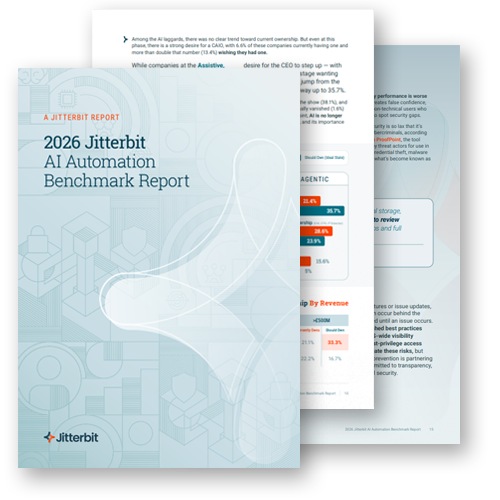 Conoce más sobre cómo las organizaciones se están acercando a la gobernanza de IA y la automatización empresarial. Descarga gratis 2026 Jitterbit Informe comparativo de automatización de IA.
Obtener el reporte
Crea, implementa y administra agentes de IA responsables con Jitterbit Harmony
La adopción responsable de IA agentiva requiere más que elegir el modelo correcto. Las empresas necesitan sistemas conectados, acceso seguro a datos y controles de gobernanza que mantengan la IA autónoma alineada con los objetivos del negocio.
Jitterbit Harmony es una plataforma unificada de bajo código, con tecnología de inteligencia artificial, diseñada para la integración, la orquestación, la automatización y el desarrollo de aplicaciones. La plataforma Harmony arquitectura de IA en capas hace posible que las empresas:
- Aproveche la IA de forma segura con compatibilidad nativa con MCP
- Integra fácilmente agentes de IA con sistemas empresariales complejos, permitiendo la gobernanza y orquestación centralizadas de agentes.
- Implementa agentes preconstruidos de confianza para flujos de trabajo comunes, o trabaja con expertos para construir agentes personalizados
- Supervisar y registrar continuamente el comportamiento del agente
El enfoque de Jitterbit centrado en la seguridad para la IA está respaldado por la plataforma de nuestro Certificación ISO 42001. Jitterbit fue el primera empresa en la industria de la automatización, integración y desarrollo de aplicaciones de bajo código para lograr esta certificación, lo que significa que cumple con el estándar internacional para sistemas de gestión de IA. Este logro se suma a una larga lista de certificaciones de cumplimiento nacionales y de la industria, así como a un sólido conjunto de medidas de seguridad y cumplimiento de nivel empresarial.
Para saber más sobre cómo la plataforma de integración con IA de Jitterbit soporta la automatización agéntica de forma segura y escalable, contactar a un experto en IA o Solicitar una demostración de la plataforma Harmony.
Preguntas frecuentes sobre gobernanza de IA agentiva
¿Qué son los “agentes fantasma”?
Los agentes "shadow AI" (IA en la sombra) son agentes creados sin la aprobación u supervisión del departamento de TI. Por ejemplo, un desarrollador podría implementar un agente de IA que monitorea continuamente su código, analiza problemas y los aborda automáticamente para mejorar la productividad. Cuando el departamento de TI queda fuera de la cadena de comunicación, aumenta el riesgo de que ese agente se comporte de manera inesperada o actúe sobre datos a los que ni siquiera debería tener acceso.
Las empresas pueden reducir los agentes sombra creando vías de desarrollo aprobadas, manteniendo un registro de agentes y exigiendo una revisión de seguridad antes de que los sistemas autónomos accedan a las herramientas empresariales.
Gobernanza en tiempo de ejecución
Gobernanza en tiempo de ejecución significa monitorear y controlar el comportamiento de un agente de IA mientras está operando, no solo durante el diseño o la implementación.
¿Qué es la ISO 42001 y por qué es importante para los agentes de IA?
ISO 42001 es la norma internacional para sistemas de gestión de IA, que abarca controles documentados, evaluación de riesgos y supervisión continua de las implementaciones de IA. Proporciona una base auditada independientemente para las afirmaciones de responsabilidad que un proveedor hace.